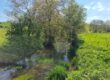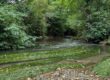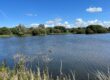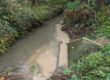
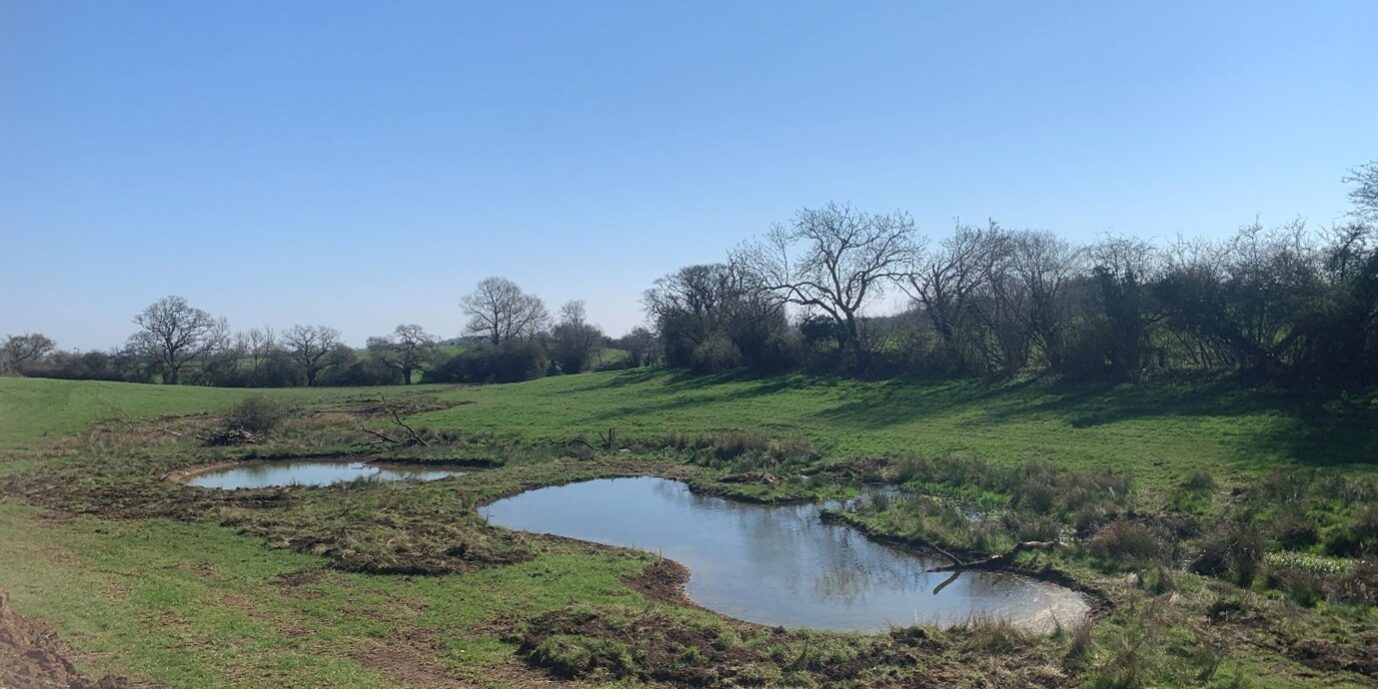
During March 2026 Bristol Avon Rivers Trust (BART) completed a large scale Natural Flood Management (NFM) project along a tributary of the Sherston Avon in the headwaters of the Bristol Avon catchment. This project has been funded by the Environment Agency and has been designed to slow the flow of water within the landscape, to help reduce the risk of localised flooding while increasing local biodiversity through the creation of seasonal wetlands.
Delivery
Work has been undertaken along two seasonally flowing streams on a farm upstream of Malmesbury in Wiltshire. Selective trees were coppiced along field boundaries, taking care not to remove trees with high bird and bat potential. The resultant large tree limbs were carefully positioned within the stream channel to slow the flow of water and encourage water to spill into the floodplain more readily. Using whole large tree limbs mimics natural processes of tree fall and retains a natural, slightly messy look to the stream helping the work blend into the landscape. Additionally, new hedgerows and woodlands are being planted through the Trees For Climate grant to increase the overall tree cover on the property.
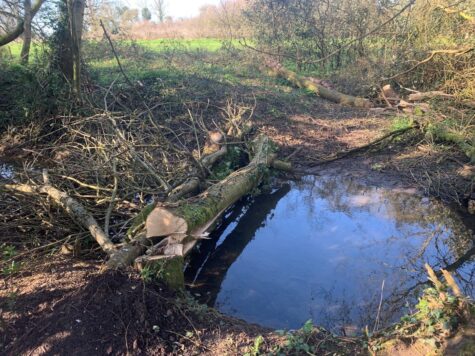
Adjacent to the stream and newly installed tree limbs, wetland scrapes have been excavated in the floodplain adjacent to the stream to increase the out of channel water storage capacity and provide important seasonal wetland habitats for a variety of birds, amphibians and invertebrate species. Each scrape has been designed to have wide shallow margins with a deeper centre and different wiggly shapes to maximise the diversity of habitats created in the project.
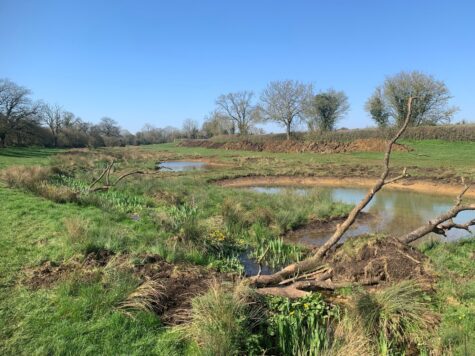
Natural Flood Management (NFM) reintroduces natural processes in our landscape, that would otherwise occur, but for human intervention. These processes create complexity, increase surface roughness and vegetation cover, mimic tree collapse and connections with floodplains, which accumulatively creates space for water to be naturally stored within the landscape, for longer periods of time, during medium to high flow events, within locations where these interventions have a positive impact to homes infrastructure and businesses. The town of Malmesbury, located in the Upper Bristol Avon over recent years has faced increased flooding causing property flooding. NFM can play a part in slowing the flow of water in the landscape, alongside more traditional methods for reducing flooding, to generate greater resilience for local communities and alongside generating new habitat to benefit local biodiversity.
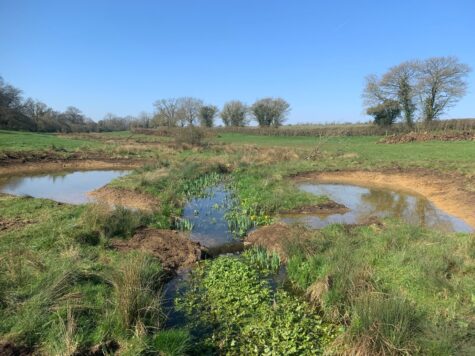
This project has been designed to allow conventional farming activities to continue around these NFM interventions, with cattle continuing to graze the fields between spring and start of winter months. We anticipate that this site will continue to evolve, providing valuable space for nature, food production and flood storage during medium to high flows, well into the future.
Subject to landowner support, and securing additional funding, BART plans to work with other landowners and partners in the region to develop a wider portfolio of NFM projects to meet the growing climate and ecological pressures impacting our rivers and communities.
We would like to thank the Environment Agency for funding this work, and our contractors Ecolibrium for their work to deliver our plans on the ground, and of course the landowner for their support throughout this project.