Project overview:
Working closely with Landowners in Queen Charlton near Keynsham over the winter season 2025- 2026, BART developed and delivered a large-scale natural flow management project to slow the flow of water and to begin restoring a degraded stream system. This work represents Phase 1 of delivering improvements previously identified on the farm to enhance the watercourse: Exploring ‘Blue’ Opportunities along Queen Charlton Brook.
What was the issue:
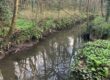
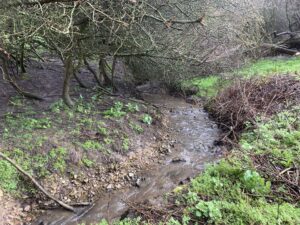
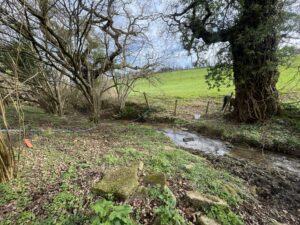
Following site walkover surveys and a review of historical mapping, we identified that sections of watercourses across the farm had been historically straightened. This has led to the channels becoming deep and disconnected from the surrounding floodplain. As a result, the channels have a reduced capacity to store water during high flows, therefore water flows quickly through the channels, increasing flood risk downstream. The modified watercourses are also less resilient to periods of drought, with several sections running dry in summer.
Large sections of the watercourses were heavily shaded, restricting bankside and in-stream vegetation growth and limiting habitat for river and terrestrial plants, invertebrates, and small mammals.
In addition, areas of land adjacent to the watercourse contained large amounts of rubbish, posing a risk to wildlife and water quality.
What did we deliver?
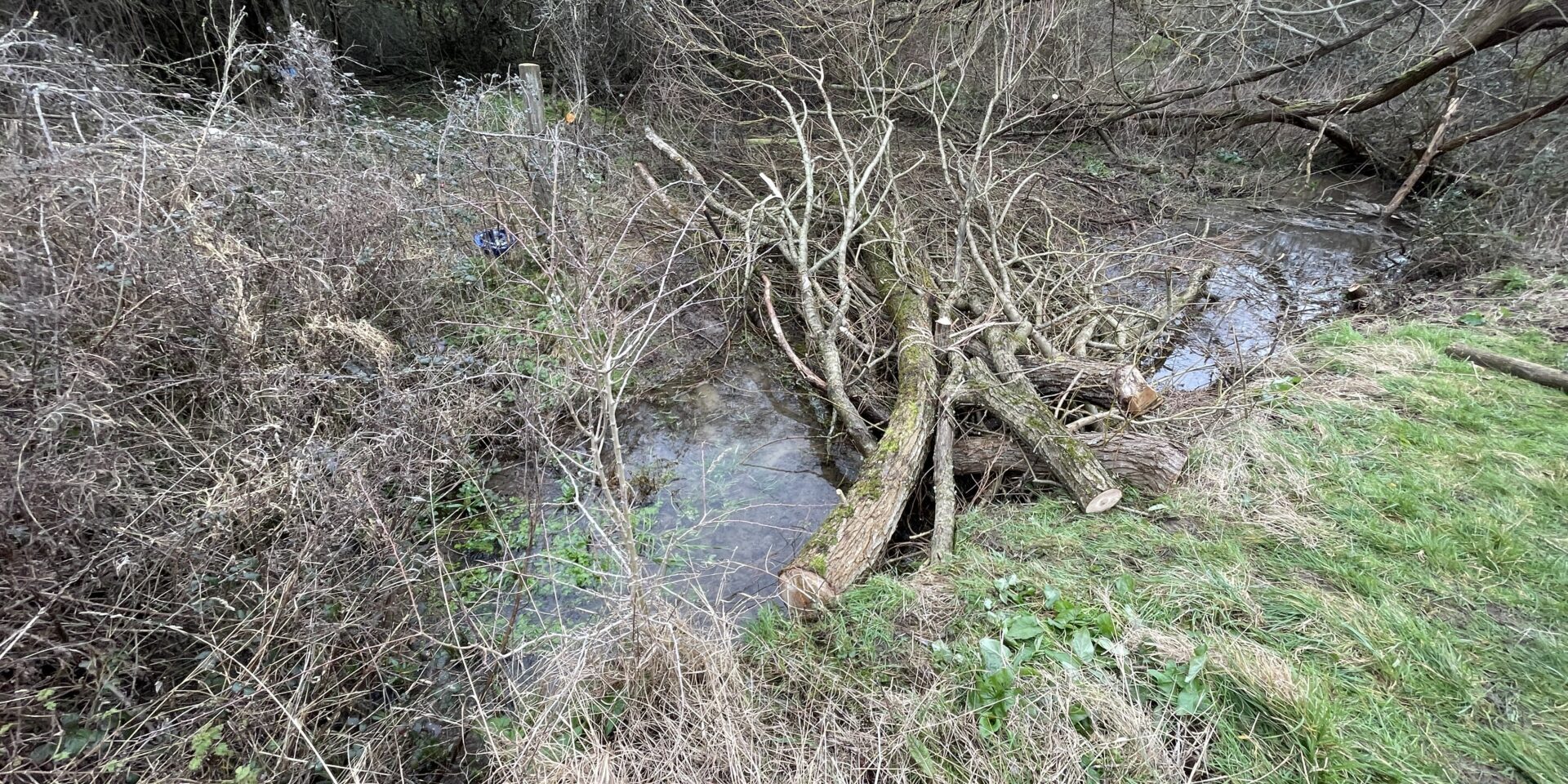
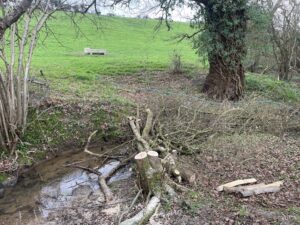
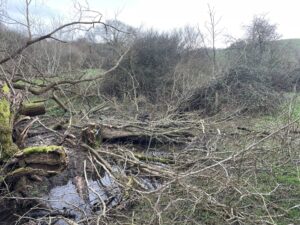
- 70 large woody structures (LWS) installed across 1,000 m of watercourse.
- A range of LWD structure types used across the site, including beaver dam analogues, hinged trees, tree root balls, designed to mimic natural tree fall and maintain a natural appearance.
- Approximately 700 m of riparian coppicing completed.
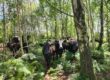
- Volunteers supported with a litter pick, removing approx. 20 large bags of rubbish from the watercourse and surrounding land.
What are the benefits of this project?
Improved in-channel habitat:
The installation of LWS will diversify flows in the watercourse, creating new pools and riffles. This provides a wider range of habitat for invertebrates and fish, which require different in-stream habitats during their different life stages. The LWS also provide refuge for fish, invertebrates and other aquatic species.
Improved terrestrial habitat:
Riparian coppicing will help improve terrestrial habitat by promoting the growth of more diverse bankside and riparian vegetation, providing a greater diversity of wildlife habitats.
Increased water storage across the site:
The LWS will trap sediment and debris, slow the flow and increase the channel’s ability to store water in high rainfall events. Overtime, sediment and debris will build up within the structures and help re-connect the channel to its flood plain. This will contribute to reducing the risk of flooding downstream.
Increase watercourses resilience to drought:
The LWS will help retain water in the channel during periods of drought, supporting refuse areas for fish and invertebrates and drinking water for mammals.
Reduce a source of pollution from litter on the site:
Removal of litter from land surrounding the river will protect water quality and reduce potential hard to wildlife.
What are our future plans?
We aim to build on the work already completed by further enhancing the watercourses across the farm and increasing their ability to store water. This will include tree planting, wetland creation, re-naturalising sections of the watercourse, and intercepting overland flow to slow and hold water within the landscape.
We also hope to engage other landowners in the catchment to extend the benefits of this work across the wider catchment.
We would like to thank the Environment Agency for funding this work, the contractors, Wayfaring Landscapes, for their support in delivering the project, and the landowners for their support and financial contribution. We would also like to thank all our volunteers for their help with the litter pick.
If you would like any more information about this project, or if you are a landowner in the catchment interested in working with us, please get in touch.